How to Taste: The DramShed Way
The following will guide you through a tasting experience. At DramShed, we want enjoyment over convention. We all taste differently, and this can depend on many factors; what you have eaten, your hydration levels, illness or just because we are all different! Here's our framework for tasting, that will empower you to rate and review whiskies, work out what you like, and build your whisky history with a tangible toolkit - the DramShed product.
You don’t have to taste the notes listed on the bottle label. What matters most is your personal experience and opinion. The main objective is to enjoy the process, enhance your love of whisky and learn about your preferences. Below, is an insight into a future DramShed feature; our Guided Tasting Experience; but you are not bound to this. If you wish to see our thoughts, please read on. But remember, it doesn't have to be a serious process, and any inexperience is not a weakness. Just have fun, enjoy the dram and taste how you like!
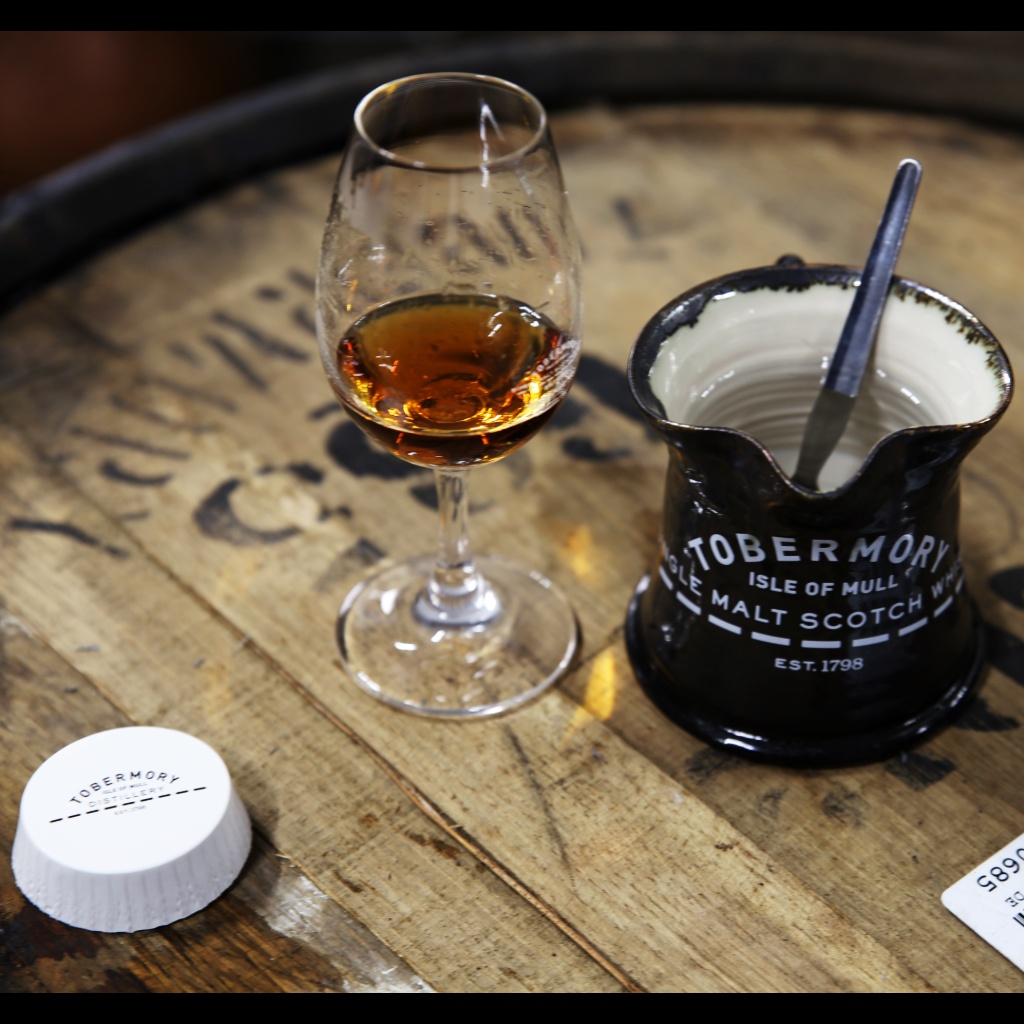
A Tasting at Tobermory Distillery, Isle of Mull, Scotland
DramShed Guided Tasting
The Colour
"When whisky is first distilled, it is entirely clear. The colour of whisky comes from the cask and the journey after distillation. The cask imparts colour to the whisky as it ages. Have a look at your whisky, preferably against a light surface, and judge the colour. The deeper the whisky*, the more impact the cask has had on the spirit.
* Some distilleries colour their whisky with a tasteless caramel additive, mainly to ensure brand consistency. An "uncoloured" whisky has taken all of it's colour from the cask(s)
The Nose (smell)
"Let’s begin the tasting process! The official term for this step is “nosing”. But that’s unimportant. Avoid taking a massive snort immediately(!), as this can knock your tasting off balance. Give the whisky a swirl in your glass, lift the glass to your nose and sniff gently. Once your nose becomes accustomed, sniff more deeply. What can you smell?
The Taste (palette)
"Now it’s time to taste the whisky! Take a small sip and begin to detect the flavour. Take multiple sips, interspersed with the odd sniff and see what you can find. You can also add a few drops of water to see if this changes or enhances your experience (this is particularly important with cask strength or stronger whiskies)
The following scale will walk you through your tasting. Remember, taste how you want to; enjoy it!
Smoky (1 of 10)
"How pronounced are the smoky characteristics in this whisky? It's important to note that smokiness differs from peaty-ness (the next category). Pay attention to the purely smoky notes; can you detect hints of bonfire or BBQ, charcoal, or smoked food? Are there any discernible notes of tobacco smoke?
1 = Less 10 = More
Peaty (2 of 10)
"Direct your attention to the medicinal and chemical flavours within this whisky. Look for notes of iodine, TCP, and seaweed. Additionally, see if you can identify any industrial elements such as coal, oil, petrol, or diesel. Are there any flavours reminiscent of steam engines or tar? Finally, pay attention to any hints of damp mulch or earthiness in the whisky's profile
1 = Less 10 = More
Sweet (Step 3 of 10)
"While all whisky exhibits sweetness, it varies along a sliding scale. Some whiskies display a pure honey-like sugariness, while others present a less pronounced level of sweetness. Explore the whisky for the presence of flavours like vanilla, maple syrup, honey, toffee, caramel, and candy-like sweetness.
1 = Less 10 = More
Woody (Step 4 of 10)
"As whisky matures in oak casks, it may acquire a woody character, although it varies depending on many factors. This can range from the distinct flavours of oak and charred wood to subtler notes of wood-chips and sawdust. Can you detect hints of sandalwood, woody-leather, or a musky woodiness?
1 = Less 10 = More
Lightness (Step 5 of 10)
"While not directly related to taste, the overall weight and mouthfeel is a crucial aspect of sampling a whisky. Consider the texture and body of the whisky. Does it feel light, subtle, gentle, and delicate? Or does it possess a heavy, coarse, and punchy character?
1 = Less 10 = More
Dried Fruit (Step 6 of 10)
"Many whiskies undergo maturation or finishing in casks previously used for other alcoholic beverages like sherry, wine, or port. This process can impart notable dried fruit characteristics. Look for the prominence of flavours such as raisins, prunes, figs, fruit cake, and Christmas pudding. Additionally, take note of any hints of marmalade, jam, or stewed fruit.
1 = Less 10 = More
Fresh Fruit (Step 7 of 10)
"Numerous whiskies exhibit citrus or orchard notes. Look out for lemons, oranges, tangerines, as well as their zesty peels. Can you taste apples, pears, and other orchard fruits? Or the subtlety of plums, apricots and soft fruit. Can you taste candied fruits and fruity confectionery, such as pear drops and lemon sherbet?
1 = Less 10 = More
Floral (Step 8 of 10)
"This encompasses more than just flowers. In addition to the scents of fresh blossoms, consider the presence of botanical elements such as plants, leaves, and the aroma of freshly cut grass. Explore the hints of fir trees and the fragrance of a summer forest and fresh herbs
1 = Less 10 = More
Malty (Step 9 of 10)
"Whisky originates from a variety of grains, including barley, wheat, corn, and rye. These distinct grain profiles often manifest in the whisky. Look for grain-like and malted characteristics akin to breakfast cereal, bran, and porridge oats. You may also identify notes reminiscent of yeast extract, burnt toast, coffee and cocoa. Can you detect hints of straw or hay bales?
1 = Less 10 = More
Spicy (Step 10 of 10)
"While commonly associated with American Rye, spicy notes can be found in many whiskies. Look for a rich nuttiness and the presence of earthy whole spices like cloves, cinnamon, allspice and nutmeg. Can you detect the presence of pepper and ginger?
1 = Less 10 = More
The "Finish" (the aftertaste / experience)
"When you swallow the whisky, what do you experience? Does it linger (long finish) or is it quick (short finish). Is it coarse or hot? Are there flavours that were not apparent in the taste?
At this stage in DramShed, we would invite you to give the whisky a rating from one to ten (1-10). We also invite you to give your whisky a DramTag; a review using no more than six words. Express yourself, for example a Laphroaig 10 could be:
"Staple Islay firestarter; medicinal and peatilicious
________
Hopefully this has given you an insight into tasting the DramShed way and remember, whenever you drink whisky, wherever you are, Pour it, nose it, sip it, DramShed it. Slainte Mhath!
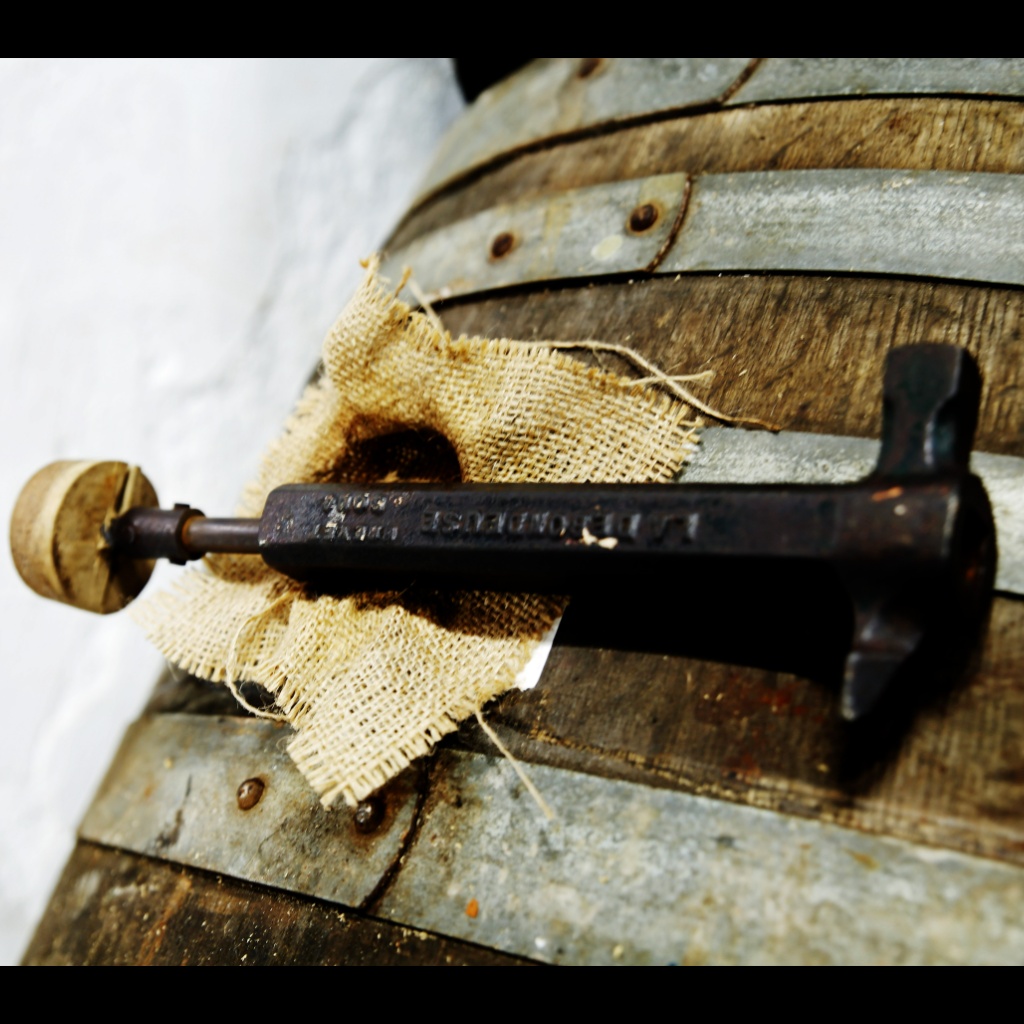
An open cask at Tobermory Distillery, Isle of Mull, Scotland